

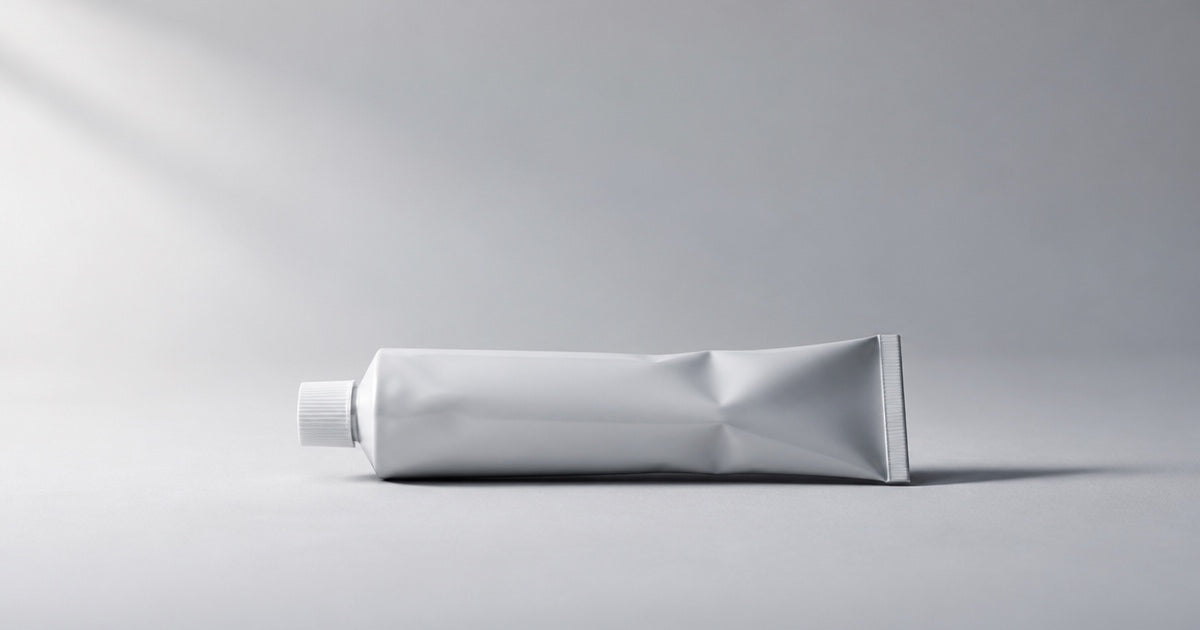
Why Is Toothpaste Still Sold in a Tube?
A 130-year-old design is sitting on your bathroom shelf
Look at the toothpaste tube by your sink. Not the paste, the tube. That soft, collapsible cylinder you pinch from the bottom, roll up when it gets low, and eventually abandon with a stubborn inch still inside. It is one of the oldest pieces of unchanged industrial design in your home. The phone in your pocket is reinvented every year. The tube has coasted for more than a century on essentially the same idea. So why is toothpaste still sold in a tube?
A short history of the squeeze
The tube did not start with toothpaste. In 1841 an American portrait painter named John Goffe Rand invented the collapsible metal tube to keep his oil paints from drying out. It was an artist's tool first, a clever little metal sleeve you could squeeze and re-cap.
Oral care borrowed the idea near the end of the century. Johnson & Johnson introduced a toothpaste in a collapsible tube, Zonweiss, in 1889. Soon after, a Connecticut dentist began selling ready-made toothpaste in tubes of his own. Before that, paste and powder came in jars and tins that everyone dipped a brush into, which was about as sanitary as it sounds. The tube solved a real problem in the 1890s: one person, one clean squeeze, no communal jar.
That is the quiet punchline. A packaging decision made to fix a Victorian hygiene problem is still the default in 2026. The paste inside has changed a great deal. If you want proof, our piece on how toothpaste is mostly water covers what is actually in the squeeze. The container around it has barely moved.
Why the tube stuck
Good designs get replaced. Adequate defaults get entrenched, and the tube is the patron saint of adequate defaults.
It stuck because it works well enough and because the entire industry is built around it. Filling lines, factories, shelf displays, and shopper habits all assume a tube. Consumers know the habit of the squeeze without being taught. When a format is that deeply wired into manufacturing and muscle memory, inertia does the rest. Nobody wakes up demanding a new toothpaste container, so nobody upstream is forced to build one. The 1890s hardware keeps shipping, decade after decade, less because it is the best answer and more because it is the answer that already exists.
What the tube quietly costs
Here is the part the design's age hides. The modern toothpaste tube is not a simple piece of metal or a single plastic. It is a laminate, thin layers of different plastics often bonded with a layer of aluminium, engineered to keep paste fresh and squeezable. That multi-material construction is exactly what makes it stubborn at end of life. Standard curbside systems are built to sort clean, single-material items, and a fused plastic-and-metal sandwich does not fit neatly into any one stream.
That is why recycling a toothpaste tube usually means a special errand, not a curbside toss. Programs exist, TerraCycle runs a brand-sponsored oral care collection that takes tubes and caps from all brands by mail-in or drop-off, which tells you something in itself. When a product needs its own dedicated program to be recycled at all, the everyday container is doing more quiet work than it appears to. We go deeper into that in why toothpaste tubes cannot be recycled.
What a dissolvable film changes
Step back and the real story is not any single paste. It is a category that has not rethought its delivery format in more than 130 years.
Mouth OS starts from that blank page instead of the tube. It is a waterless dissolvable toothpaste film, sold as individually sealed Precision Doses. The routine is unchanged: you place the film on the front of the teeth and brush, with water and a sink, the same couple of minutes as always. What changes is the object. There is no cylinder to pinch, no rolled-up bottom, no last inch you cannot reach, and nothing to re-cap. A flat, pre-measured, individually sealed dose is simply a different shape than a collapsible tube, and that shape travels and stores differently. If you have ever wrestled a tube through airport security, our guide on whether you can bring toothpaste on a plane shows how much of that friction is the format's fault.
None of that is a knock on paste itself. It is a question about the packaging we stopped questioning. The tube was a smart answer to an 1890s problem. The interesting design work now is asking whether that answer still deserves to be the default.
The takeaway
Next time you roll up the bottom of a tube, notice that you are operating a piece of Victorian engineering. It earned its place. It also never had to defend it. The Mouth OS Journal exists to ask the obvious question the category skipped: if we were inventing toothpaste today, would we really reach for a 130-year-old tube? Follow the Journal as we keep pulling that thread.
Sources: Jamie Matusow, "Not Your Great-Grandmother's Toothpaste Tube," Beauty Packaging, May 31, 2022. TerraCycle, "Colgate Oral Care Free Recycling Program," terracycle.com. Both accessed 2026-08-27.

Written by Joshua Stancle

Leave a comment
This site is protected by hCaptcha and the hCaptcha Privacy Policy and Terms of Service apply.