

Article: Why Your Mouth Feels Terrible on Long Flights (and What Actually Helps)
Why Your Mouth Feels Terrible on Long Flights (and What Actually Helps)
The seatbelt sign goes off, you stand up, and your mouth tastes like an attic. Nothing hurts exactly. It just feels stale, tacky, and vaguely upholstered.
Most of us blame the pretzels. The bigger culprit is the air.
Cruise-altitude cabin air is drier than almost any room you have ever been in
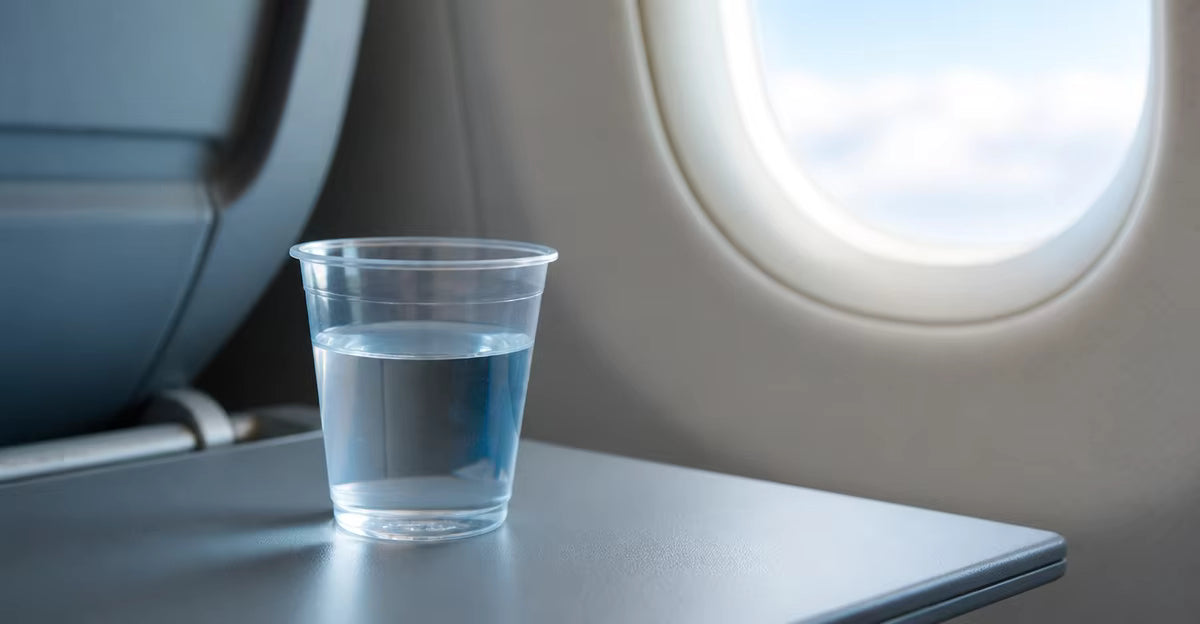
The Aerospace Medical Association puts it plainly: "Today's aircraft have low cabin humidity, usually ranging from 10-20%. This is unavoidable because the outside air at high altitude is practically devoid of moisture." The consequence it names is not exotic. There "can be a drying effect of airway passages, the cornea (particularly under contact lenses), and the skin." (Aerospace Medical Association, Stresses of Flight)
The National Academies' review of the airliner cabin environment lands in the same place, reporting "typically 10–20% relative humidity at cruise altitudes," and notes that ASHRAE's comfort standard set lower relative-humidity limits "from about 20% to 30%, depending on the temperature." (National Academies Press, The Airliner Cabin Environment and the Health of Passengers and Crew)
- Commercial cabin at cruise altitude. 10% to 20% relative humidity. Source: Aerospace Medical Association; National Academies.
- Lower bound of the ASHRAE comfort range. About 20% to 30%, depending on temperature. Source: National Academies, citing ASHRAE Standard 55–1992.
Our read: a transcontinental flight is not a slightly dry room. It sits at or below the floor of what a comfort standard was willing to call comfortable, and it stays there for the length of the flight.
The Three Dry Inputs: a simple framework for the post-flight mouth
The stale-mouth feeling is not one thing going wrong. It is three ordinary inputs stacking up inside a small pressurized cabin. We call them the Three Dry Inputs. Naming them is most of the fix, because each one has its own boring, effective answer.
Input 1: the air
Sourced: cabin humidity runs 10% to 20% and dries airway passages (Aerospace Medical Association).
What to do: nothing clever. You cannot argue with the ventilation system. You can stop making it worse.
Input 2: what you order from the cart
Sourced: the Aerospace Medical Association writes that "there is no core dehydration if the passenger continues normal intake of fluids, but limiting alcohol and caffeine." The National Institute of Dental and Craniofacial Research is blunter on the oral side: caffeine "can dry out the mouth," and tobacco and alcohol "dry out the mouth." (NIDCR, Dry Mouth)
What to do: the free water is the good order. The second coffee and the complimentary wine are the two inputs you actually control at 35,000 feet.
Input 3: saliva, which you only notice when there is less of it
Sourced: the American Dental Association describes saliva's day job this way: it "washes away food and other debris, neutralizes acids produced by bacteria in the mouth and provides disease-fighting substances throughout the mouth." NIDCR adds that saliva "moistens and breaks down food, washes away food particles from the teeth and gums, and helps people with swallowing." (ADA MouthHealthy, Dry Mouth)
What to do: the ADA notes that "sugar-free candy or gum stimulates saliva flow." NIDCR says the same and adds sipping water through the flight rather than in two heroic gulps.
Our read: the mouth is not doing anything unusual on a plane. It is doing exactly what it always does, in an environment that gives it less to work with, for longer than usual, while you sleep through part of it.
One thing worth saying clearly about dry mouth
Persistent dry mouth is not a travel quirk. The ADA is precise about this: dry mouth, or xerostomia, "results from an inadequate flow of saliva. It is not a disease, but a symptom of a medical disorder or a side effect of certain medications, such as antihistamines, decongestants, pain killers, diuretics and many others."
So if your mouth is dry on the ground, on a Tuesday, with no boarding pass involved, that is a conversation for your dentist or physician, not a packing problem. The flight is a temporary environment. A persistent symptom is a different subject entirely, and it is worth taking seriously. Our piece on why oral health is not just about your smile covers why the category deserves that attention.
The long-haul checklist
Every item below comes from the sources cited above.
- Sip, do not chug. NIDCR recommends drinking water steadily, including during meals.
- Treat alcohol and caffeine as a budget. Both the Aerospace Medical Association and NIDCR flag them.
- Pack sugar-free gum. The ADA lists it as a way to stimulate saliva flow, and it clears the liquid rule without a thought.
- Skip the tobacco. NIDCR names it alongside alcohol as drying.
- Brush when you land. Not because the flight did something to your teeth, but because a normal routine interrupted by a time zone is still a routine worth keeping.
- Know the rule before the checkpoint. Toothpaste reads as a gel to security. We broke that down in our guide to the TSA liquid rule and toothpaste.
What actually earns space in the bag
That last checklist item is about packing, not biology. Worth keeping the two apart.
Traditional toothpaste packages a water-heavy paste inside a bulky collapsible tube. Mouth OS takes a different approach: a sealed, waterless Precision Dose designed to be placed directly on the front of the teeth before brushing. The routine does not change. You open one sealed Precision Dose, place the film on the front of the teeth, and brush as usual. Water, sink, two minutes, all still there.
What changes is the packing. One box holds 60 Precision Doses, a 30-Day Supply, each one individually sealed and TSA-friendly. It is fluoride-free, with a Waterless A.C.E. Technology™ formulation. Compared with a collapsible tube, it is a smaller, flatter thing to put in a bag, with fewer liquid-related complications at the checkpoint.
To be unambiguous, because this article is about a dry cabin: Mouth OS is not a dry-mouth product, and we are not going to imply that it is. It does not treat, relieve, or prevent dryness. It changes the container and the format, nothing more. If you want the argument for why the format is worth changing at all, we made it in our piece on how much of your toothpaste is water.
The dry-cabin fixes are water, gum, and restraint at the drink cart. The format fix is a separate conversation, and it happens at the suitcase.
Sources
- Aerospace Medical Association, Medical Guidelines for Airline Travel, "Stresses of Flight," September 2014. asma.org. Accessed July 31, 2026.
- National Academies Press, The Airliner Cabin Environment and the Health of Passengers and Crew, "Environmental Control." ncbi.nlm.nih.gov. Accessed July 31, 2026.
- American Dental Association, MouthHealthy, "Dry Mouth." mouthhealthy.org. Accessed July 31, 2026.
- National Institute of Dental and Craniofacial Research, "Dry Mouth." nidcr.nih.gov. Accessed July 31, 2026.

Written by Joshua Stancle

Leave a comment
This site is protected by hCaptcha and the hCaptcha Privacy Policy and Terms of Service apply.