

Can You Bring Toothpaste on a Plane? The TSA Liquid Rule, Explained
Everyone in the security line has watched it happen. Someone gets pulled aside, a bin gets rerouted, and an officer holds up a half-used tube of toothpaste like it is evidence. The traveler is baffled. It is toothpaste. It is not a liquid.
Except, as far as the checkpoint is concerned, it is. Here is what the rule actually says, where toothpaste lands inside it, and the arithmetic that decides whether your quart bag closes.
What the 3-1-1 rule actually says
The Transportation Security Administration publishes the limit plainly. Each passenger may bring liquids, gels and aerosols in travel-size containers that are 3.4 ounces or 100 milliliters, and each passenger is limited to one quart-size bag of them.
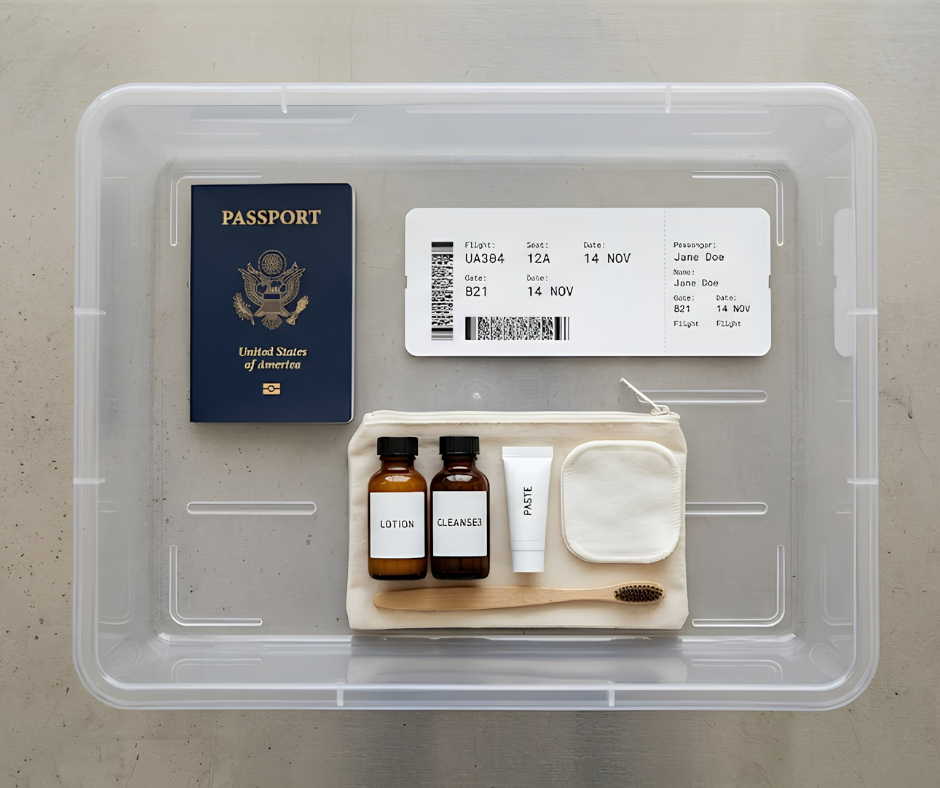
TSA's own travel tips fact sheet breaks the three numbers apart: 3.4 ounces or less for liquids, gels, aerosols, creams and pastes; 1 quart-sized, clear, plastic, zip-top bag to hold the liquids; 1 bag per passenger placed in screening bin. That is the whole rule. Three, one, one.
Anything bigger is not contraband. It is simply carry-on ineligible. TSA's guidance is to pack items that are in containers larger than 3.4 ounces or 100 milliliters in checked baggage.
Does toothpaste count? TSA says so by name
It does, and you do not have to infer it. TSA's own explanation of the 3-1-1 rule lists the products it has in mind: toothpaste, shampoo, conditioner, mouthwash and lotion.
The category that catches it is "pastes." A paste is not a liquid in any everyday sense, and that is exactly why the rule confuses people. The checkpoint is not sorting by whether something pours. It is sorting by whether something can be squeezed, spread, or otherwise behave like a fluid in a container. Toothpaste qualifies on the first try.
One correction worth making early, because it costs travelers the most: the rule measures the container, not the contents. A 4 ounce tube with one ounce left in it is still a 4 ounce container.
The Quart-Bag Budget: the arithmetic almost nobody runs
Here is the part of 3-1-1 that gets skipped. Two of the three numbers are limits on the same thing, and they interact.
The math, shown transparently:
- A US liquid quart is 32 fluid ounces, per the National Institute of Standards and Technology.
- TSA caps each container at 3.4 fluid ounces.
- 32 divided by 3.4 is 9.41.
So the arithmetic ceiling is nine containers. That is the theoretical maximum number of maxed-out travel bottles a quart bag could hold if volume were the only constraint. It is not a TSA-approved container limit, and TSA publishes no container count at all.
It is also not what happens in practice. This is Clean Saint's read rather than a TSA figure, and we want the line between the two to stay visible: the practical number is meaningfully lower than nine, for two reasons that have nothing to do with the rule. First, the bag has to actually close, and TSA is describing a zip-top bag, not a bag stretched around its contents. Second, rigid bottles do not tessellate. Cylinders packed side by side leave air between them, and that wasted space is charged to your budget at full price.
Call it the Quart-Bag Budget. You are not allocating 32 ounces. You are allocating roughly six to eight usable slots, and every squeezable item in your dopp kit is bidding for one. Toothpaste, in a tube, bids for a slot the size of the tube rather than the size of what is inside it.
Reframed that way, the question stops being "will this fit" and becomes "is this worth a slot."
A carry-on checklist that respects the budget
- Count containers before you pack them. Nine is your ceiling. Six to eight is your realistic working number.
- Read the container, not the contents. Capacity printed on the packaging is what the checkpoint measures against.
- Send the big items ahead. Anything over 3.4 ounces goes in the checked bag, per TSA's own instruction, not in a hopeful outer pocket.
- Spend slots on things with no alternative format. Prescription items and contact solution earn their place. A full-size body wash usually does not.
- Audit the bag, not the suitcase. The quart bag is the only part of your packing the checkpoint actually adjudicates.
- Assume nothing about novel formats. See below.
Powders get their own number
One rule that catches people out: powders are governed separately. TSA advises that powder-based substances in carry-on baggage greater than 350mL or 12 oz. may require additional screening, and that powder-like substances over that threshold which cannot be resolved at the checkpoint will not be allowed into the cabin.
So powder is not a loophole. It is a different rule with a different number.

Where format changes the packing math
Every workaround people trade around the boarding gate is really the same move: change the format so the item stops competing for a slot in the quart bag.
A word of honesty here, because this is where travel articles usually overreach. TSA's published liquids rule names liquids, aerosols, gels, creams and pastes. It does not publish an item-level ruling for every format on the market, and we are not going to tell you how any specific product will be classified at any specific checkpoint. Check current TSA guidance before you fly, and remember that the final screening decision rests with the TSA officer at the checkpoint. What we will tell you is the part that is not in dispute: a tube of paste is squarely inside the rule, TSA says so by name, and the bulk you are packing is largely the container.
Which raises the obvious question about the tube. Conventional toothpaste packages a water-heavy paste inside a bulky collapsible tube, which is also why most of what you are carrying in that tube is water, and why the tube itself is so difficult to recycle. The format is doing a lot of work that nobody asked it to do.
Mouth OS takes a different approach: a sealed, waterless Precision Dose designed to be placed directly on the front of the teeth before brushing. One sealed dose, a Waterless A.C.E. Technology™ (Active Cellular Emulsion) formulation with no water inside the formulation, and a compact individually sealed format instead of a bulky collapsible tube. It is fluoride-free, it is TSA-friendly, and it packs flat. A box is 60 Precision Doses, a 30-day supply.
To be clear about what it does not do: it does not replace brushing. You open a dose, place the film on the front of your teeth, and brush as usual. Water and a sink are still part of that routine. What changes is what you are packing, not where you are standing.
And keeping that routine intact on the road is not a vanity concern. We looked at why separately: oral health is not just about your smile.
The short version
Toothpaste counts. TSA names it. Your quart bag holds nine maxed containers on paper and fewer in practice, so treat it as a slot budget and spend it deliberately. Anything oversized goes in the checked bag. Powders have their own threshold. And the fastest way to win the packing argument is to stop packing the container.
If the oral care corner of your dopp kit is still built around a tube, there is a flatter way to do it. Make the switch.

Written by Joshua Stancle

Leave a comment
This site is protected by hCaptcha and the hCaptcha Privacy Policy and Terms of Service apply.